
There you are, shopping at your favorite big box store, when around the corner comes the most amazing thing I’ve ever seen! Oh my gosh! It’s a Service Dog! What do I do? It’s the coolest thing ever! Aaaaah! I just can’t even! It’s so cute! I have to pet it! I have to talk to it! Oh my god! Oh my god!
Seem ridiculous?
That’s the kind of behavior Service Dog handlers have to deal with every time they go out to try and do something as simple as buy groceries. Not sometimes. Not on occasion. Every. Single. Time. They. Go. Out.
People’s ridiculous overreactions to the presence of a Service Dog has driven some handlers to the point of no longer using their Service Dogs at all in public. Why? Because the constant interference make things more stressful for the handler than they are able to deal with, so they opt not to use their Service Dog, and often return to the isolation and lack of quality of life the dog was trained to help mitigate.
Here are some things you need to know about that Service Dog you’re gushing over:
- That dog is not there for your entertainment. That dog is there, in a place where dogs are not normally allowed, because its handler is disabled, and the dog has been trained to perform work or tasks to assist its handler with their disability. Service Dogs are not just for blind people. Service Dogs can assist with mobility, can alert to changes in the handler’s blood sugar or blood pressure, and can even detect and alert the handler to changes in hormones such as adrenaline, and help redirect the handler’ attention when they’re experiencing psychological difficulties.
- Disabled people use Service Dogs to assist them in order to regain independence. Service Dogs complete work or tasks the handler would otherwise be unable to complete without the dog’s assistance. They are highly trained in order to do this. Interfering with a working Service Dog could endanger the handler’s life. That dog is there for a reason.
- Service Dogs are not accessories, they are necessities. A Service Dog is just as necessary to its handler as a wheelchair – in fact, the Americans with Disabilities Act offers the same access protections for Service Dog handlers as it does for wheelchair users. Legally, a Service Dog is equivalent to durable medical equipment, the same classification as the wheelchair.
- The handler is just trying to do the same thing you are trying to do: go shopping, or watch a movie, or have lunch in a nice restaurant, or register their car … That handler did not bring their dog in order to garner attention, they did not bring the dog so that you could fawn over it; they brought their Service Dog because it is their lifeline, and, for many handlers, is often the only reason they are even able to get out of their house on any given day.
- Not all disabilities are visible. Service Dogs can be trained to assist handlers with epilepsy, diabetes, post traumatic stress disorder, anxiety, heart issues, and much more. Just because the handler does not look disabled does not mean they are not disabled. If you must make a judgement as to whether or not it’s really a Service Dog, pay attention to its behavior. The difference between a highly trained Service Dog and a pet is immediately evident.
- You are not the Service Dog police! If a dog present in a business is causing issues, it is the right and responsibility of the business to ask that the handler remove the animal. Go find a manger if you think there is a problem.
- Yes, the Service Dog is extremely well behaved! It has been trained to be well behaved! So why are you trying to distract it and encouraging it to mis-behave? LEAVE SERVICE DOGS ALONE. The dog is there to assist its handler. Equate the dog to a wheelchair, walker, or cane. Treat it accordingly.
- Please talk to the handler. One of the biggest complaints Service Dog handlers have is that they’re treated like they don’t exist while people try and distract or interact with their dog. That’s exactly backwards: talk to the handler, pretend the dog is not there.
- Distracting or interfering with a Service Dog is criminal activity in many states – in fact, touching a Service Dog or physically interfering with it is considered assault in most places. I say again, LEAVE SERVICE DOGS ALONE.
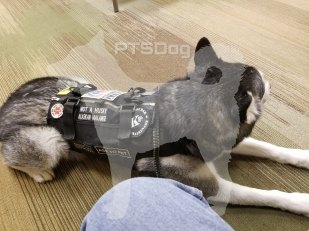
- Service Dogs do not have to be marked. Many handlers use a vest, leash wrap, special collar or other devices to easily identify their animal as a Service Dog. This is a courtesy, not a requirement. The Americans with Disabilities Act does not require handlers to mark their dogs, nor does the law require or recognize certification or registration as having any bearing on the dog’s legitimacy.
Educate yourself! If you really, really want to know more about Service Dogs, you can read the ADA’s explanation of the law! Here’s a link: https://www.ada.gov/regs2010/service_animal_qa.html.
Learn more about the ADA and PTSD Service Dogs in the book PTSDog: Post Traumatic Stress Disorder and the Service Dog, available at booklocker.com, amazon.com and barnesandnoble.com.

 Conestoga Chuck